Showing posts with label english. Show all posts

Reading Oscars 2011

Sunday, January 1, 2012

0 comments

Best Fiction
Le Club des incorrigibles optimistes by Jean-Michel Guenassia
The Eastern Europe emigre culture in Paris through the eyes of a young French boy
That was a surprise since it edged the stunning This boy's life by Tobias Wolff right at the end of the year. My review on Wolff's book -->http://www.librarything.com/review/67997688. Third place goes to The Thought Gang by Tibor Fischer, my review -->http://www.librarything.com/review/72769157

Best Short Novel
Les Naufragés by Hernàn Neira --> http://www.librarything.com/work/12081618/book/81210760
Kafka meets Lord of the Flies in this short novel that would surely feature in Colin Wilson's diatribe about "The Foreigner" in literature if it had been written some decades earlier.

Best Short Stories Collection
Stories of your Life: and Others by Ted Chiang
This could well be the science fiction book of the year for me, but I decided to choose a full novel for that category. An Arthur Clarke would write 30 books using the ideas that Ted Chiang fitted in this short collection
State of the art by Iain Banks was my first read of 2011 and a deserving finalist for this category. Moreover, it's a must-read for Culture afficionados since it includes the only appearance of planet Earth on the whole Culture corpus.

Best Weird Fiction
Nazi Literature in the Americas by Roberto Bolano
My Review --> http://www.librarything.com/review/72615074

Bolano could very well take all awards in this category but I would like to mention Enigma by Rezvani which inspired me to write my first ever review on librarything --> http://www.librarything.com/review/68059403

Best History Book
A People's History of the United States: 1492-Present by Howard Zinn
Made in America : an informal history of the English language in the United States by Bill Bryson would probably win it if it wasn't for that economic crisis that makes Zinn's work so important for the current state of affairs.

Best non-fiction other than history
Raw Spirit by Iain Banks
A book that made me spend some valuable cash on single malt whiskey :)
The Island of lost maps by Miles Harvey also gets a mention

Best Science Fiction
Use of Weapons by Iain M. Banks
My Review --> http://www.librarything.com/review/67798833

The Quiet War and its sequel Gardens of the Sun by Paul McAuley were also great fun to read.

Best Chess Book (excluding those that actually try to improve your game)
Correspondence Chess in Britain and Ireland 1824-1987 by Tim Harding

Best Read by an Author new to you in 2011
The Amazing Adventures of Kavalier and Clay by Michael Chabon
My Review --> http://www.librarything.com/review/70604607

What a book! Worths the hype

Best Biography/Autobiography
Speak, Memory by Vladimir Nabokov
My review --> http://www.librarything.com/review/70604553

I have a couple of biographies queued for early 2012, Howard Zinn's for starters and Like a Fiery Elephant, Jonathan Coe's take on the novelist and poet B.S.Johnson.

18...19

Monday, May 9, 2011

2 comments

1994


2011


Thank you Sir


Tibor Fischer - The Thought Gang

Sunday, May 1, 2011

0 comments

The Thought Gang by Tibor Fischer

Zeno, Zeami, Zapffe, Zalta, Zabarella, Zeller, Zermelo, Zhai, Zizek, Zaborowski, Zacuto, Zafarani, Zaremba...

English Philosophy Professor at Cambridge Eddie Coffin, an anti-hero that reminds one of the cop's cynicism in Irvine Welsh's Filth combined with the literacy of an Arsene Lupin, runs amok and flees to France, guilty of embezzlement of funds from various educational institutions, loses all his loot in an unlucky car accident and ends up broke in Montpellier. He's an uncured alcoholic and obsessed with the letter Z.


...Zhiyi, Znaniecki, Zongmi, Zubiri, Zarathustra, Zallinger, Zigliara, Zariski, Zelmanov, Zeuthen, Zimmermann...

A petty thief, a cripple raised in an orphanage who spends most of his time in prison becomes his partner in a series of spectacular and eccentric bank robberies that put the local police in a state of panic. The duo educates one another on philosophy and weaponry, on logic and escapism and become a highly effective criminal organization, nicknamed "The Thought Gang" quoting Diogenes Laertius while relieving a bank's treasury and discussing about Thales of Miletus while eyeing their next targets.

...Zizler, Zolotarev, Zuckermann, Zygalski, Zielinski, Zafra, Zaide, Zinn, Zitelmann, Zelazny, Zola, Zemlinsky

Tarantino meets Monty Pythons meets the Ionian School of Thought. Zuberb!

5/5 Stars

Reviewed at the social site for books and libraries http://www.librarything.com by trandism


On Nabokov's Autobiography

Friday, April 22, 2011

0 comments

Speak, Memory by Vladimir Nabokov

Chess was the reason I "discovered" Vladimir Nabokov many years ago. I know that it sounds funny, like "discovering" Montalban because of cooking, but in my case I managed both. I wonder how many amateur lepidopterists got attracted to Nabokov's work because of "Plebejus (Lysandra) cormion Nabokov", a small blue-grayish butterfly that the Russian author first discovered and described in an entomological journal in the early 40s. Not many I guess. With chess is different. Nabokov's chess compositions are known to only a selected few, chess composition being a rare pastime even amongst chess players, but his "Защита Лужина", Luzhin's Defence, is one of the most important pieces of chess fiction. Inspired by the life and death of Count Von Bardeleben, Nabokov manages to describe certain aspects of the chess psyche and those who wander around amateur chess tournaments have met many a chessplayer with behavioural similarities to Luzhin, although we don't see such things at the top level anymore.

I have in my hands the Everyman's Library Edition of Speak, Memory, Vladimir Nabokov's autobiography and I mention it because I liked this edition a lot - its paper, its binding, its b/w photos. I also liked the introduction by Brian Boyd, an experienced "Nabokovist" (having written books on Ada and Pale Fire). Nabokov's work seem to raise a certain excitement amongst scholars and therefore many of them have written studies about his novels or extensive notes included in editions around the world. A good example is an excellent Greek translation of Lolita that has 250 pages of additional notes, following the steps of Alfred Appel Jr's efforts who died 2 years ago at 75 having extensively annotated that same novel. "Speak, Memory" consists of 16 chapters - written independently and in a different order than the one they appear in the book - spanning the "European" part of Nabokov's life, from pre-revolutionary Russia, his family's runaway trip to the south to save themselves from the Bolsheviks and their imminent departure to Europe after the Whites lost the Civil War, his life in exile as a Russian Emigre, up to his second runaway journey - this time to get away from the Wehrmacht - from France to New York.

Seventy years of communist propaganda tried to convince the rest of the world that Russia went from the Middle Ages straight to Lenin and it took more than two decades and Stalin's Great Terror for the Western Intelligentsia to start questioning those certainties and discover the fact that pre-Bolshevik Russia was a relatively liberal society, especially if someone compares it with the post-1917 Soviet State. Russian emigres like Nabokov were trying to inform people in the West about this, but most of them, blinded by Lenin's buzzwords about the working class attributed this hostility to bitterness about properties lost and fortunes expropriated. Nabokov himself had great contempt for those emigres who kept whining about their lost fortunes without having any sense on what was going on politically in their country either before or after the October putsch. Nabokov's father was a prominent liberal, one of the most well-known anti-tsarists of the period. One of his childhood memories consisted of watching his father write yet another flaming article to be published in a liberal newspaper. This image of someone being free to write what he wishes against the regime was something that Nabokov would not live to see again in Russia. One could say that the 1890-1917 years were much more liberal than today's post-perestroika Putinist Russia. Of course Nabokov doesn't care about the fact that most of his countrymen were striving for food and firewood in order to survive and couldn't appreciate the political climate of the 1900s. Better to be unequal and free than "equal" in a prison-state.

Nabokov also talks about Russia's countryside, climate and most of all butterflies and moths. He chronicles this great passion of his that entertained him all throughout his life, wherever destiny threw him from the Urals to America's West Coast. He talks about his school, his friends, his first love but most of all, about his governesses and tutors - scores of them! - English, French, Poles, Jews, who accompanied him during the summer months to whichever European resort was chosen that particular year, his drawing and music tutors becoming desperate with what they saw as a talentless young boy. His genealogy also takes an important place in his memoirs, a family tree that spans impressively three centuries full of celebrities and scandal. One can easily keep on listing subjects like this, but this falls short of describing the magic of the text. It's not what he writes about, but how he writes it. Clever, dense, sometimes peculiar and eccentric, these were easily the slowest 250 pages I ever read if we exclude the tortures of the school years. And no matter how spontaneous or thoughtful, political or literary a review like this might be, it cannot beat the last chapter of the book, "On Conclusive Evidence", a pseudo-review that the author applies to himself and his own work, one of the best literary reviews I ever read, a brilliant exercise of watching one's own work from the necessary distance.

5/5 Stars

Reviewed at the social site for books and libraries http://www.librarything.com by trandism


Iain M. Banks - Surface Detail

Monday, April 11, 2011

0 comments

Surface Detail by Iain M. Banks

Hell and Paradise certainly do not exist. However, humans have been trying with various degrees of success to create both of those on Earth. Prisons, more specifically, are playing the role of hell-on-earth, a place where "bad" guys go to be punished. The main theme of Banks' latest Culture Novel is virtual Hells. Some species do not see life as a series of consecutive parties like the Culture does, although their tech levels allow them to stop caring about resources. The Culture is of course dissapointed with that, but their self-induced non-interfering foreign policy does not let them take matters into hand and "convince" those decadants by force. Other species do not share these non-intervention ideals and soon a war between pro-Hell and anti-Hell camps is due. This war will not take place in the Real. Both sides of the conflict agree to fight a Virtual War in order to spare lives and resources.

Parallel to that, a girl tries to escape from her master and becomes the prey to his hunting fetish once more. The girl, victim of an ancient socioeconomic relic of her species had been her master's compensation for a family debt that could not be repaid properly. This time, the whole incident goes out of proportions and ends with her murder by her own master's hand. The fact that a Culture Ship has backed her up and provided a neural lace to her without anyone, including herself, knowing it, becomes the catalyst for a series of developments with far-reaching consequences. As a matter of fact, it goes so far that it turns out to be the start of the completion of the Hell War. At the end of it all, the prey becomes the hunter.

Good 'ol science fiction (Asimov et al) has often been accused of being low-quality literature in terms of language and character development and all that. I was always of the opinion that these things, important as they might be, cannot and should not eclipse the brilliancy of Asimov's fantastic worlds, but even I acknowledge the fact that most of the great totems of the genre were not the best writers of their times, their language wasn't on par with their creative imagination. Iain Banks does not fit this category. And I quote "...like many societies finding their hitherto unquestioned customs and ethical assumptions impacting squarely with the breath-takingly sophisticated summed morality of a meta-civilisation inestimably older, vaster and by implication wiser than themselves, the Sichultia became highly protective of their developmental foibles, and refused to mandate away what some of them at least claimed to regard as one of their defining social characteristics and a vital and vibrant part of their culture..."

Iain Banks is a phenomenon!

Reviewed at the social site for books and libraries http://www.librarything.com by trandism


Michael Chabon - The Amazing Adventures of Kavalier and Clay

Monday, March 28, 2011

0 comments

The Amazing Adventures of Kavalier and Clay by Michael Chabon

I admit I wasn't aware of the existence of a Pulitzer Price for Fiction. I also admit that I am one of those stubborn people that refuse to read/listen to best sellers, just because you know: "This world sucks. This world likes this book. Therefore, this book might as well suck". And to be honest, this strategy of mine has protected my eyes and ears from various junk through the years. But sometimes...
I was attracted to Michael Chabon and more specifically The Yiddish Policemen's Union due to its chess theme and the nice reviews it got from members of librarything. Then, those same people - even in this forgotten thread of mine - gave the thumbs up for this magnus-opus of Chabon's, The Amazing Adventures of Kavalier and Clay .


Chabon weaves an amazing story which starts with an escape from the nazi-striken Prague of a talented jewish kid destined to become one of the most important artists of American's golden superhero comic age, takes us through the World War II and this youngster's vain attempts to take revenge for his lost family - a mother held in the concentration camps and a brother at the bottom of the Atlantic, his "boat of hope" torpedoed by one of Third Reich's submarines - and ends with this man's return to normal life and New York, a hermit unable to find the proper way to reapproach his son, his son's mother and his cousin and ex-partner who live under the same roof in the suburbs.

Entrepreneurship, mass-media, surrealism, a country which is about to transform from a Depression-stricken mess to world's number one superpower, the paradox of two military camps in Antarctica which on the verge of destruction by the cruel polar nature are obliged to exterminate one another, homosexuality and comics. While leafing through this 600-page-plus masterpiece world-changing events took place. A lethal earthquake that hit one of world's most advanced societies, the Arab World rising against its tormentors, the world's most frighting military machine bombing a country to "liberate" it from a dictator. One wonders if a Chabon of the future will ever be able to write a story about these events. A story with such a touch of genius.

Reviewed at the social site for books and libraries http://www.librarything.com by trandism


Current 93

Thursday, March 24, 2011

0 comments

Αύριο (στις 24 Μαρτίου) στο Gagarin (Λιοσίων 205), στις 9 το βράδυ, εμφανίζονται οι Current 93, για τους οποίους ομολογώ την αδυναμία μου να γράψω το οτιδήποτε λογικό.


Lyrics to They Returned To Their Earth (for My Christ Thorn) :
When serpents come
They cover the Christ thorn
Two heads
And cock heads
Serpents feet of emotion
Lidded eyes and smudged reality
Everything has two faces
One is earthly without true form
The other blackened and blackening

And mother is in the fields
Father is in the fields

You know well its tortured form
It's locked within a particular place
It's locked within a particular form
It's jailed by a falling light
With angles shapes and size
It's held by true what
It's held in through place
It's an aim that has no name

Mother is in the fields
Father is in the fields

It's a form creating formless
Formless creating form
Oh four towers reaping backwards
Do not spell the sound
Do not move to the lies
Speak the words and they create the universe
And they destroy all universe

Mother sleeps in the fields
And father he reaps in the fields

Heavy-lidded eyes do not mask his pain
They shade us from the burning light
Listen one face one form one truth
I see it through the shading glass
I see it fractured in the world
This is not true
It's appearance only

Mother is in the fields
Father is in the fields

An eagle flies his bloody face
Behind bloody claws behind bloody claws
His pain is blackened rain
His rain is Roman
Sire the pain it is not finished
I happens now
Matchstick man in a matchstick world
Nake the prime slice the sickle
Nake the sickle slice the core
Time stops when he was thirty-three

And mother is in the fields
And father is in the fields

Time stops when i am thirty
Time stops then and time stops there
Then is now
Oh why do we not say it
Time stops time breaks time folds
Time ceases
And pestle grindes the mortar
The mortar turns to dust
The metal turns to rust
Words they fail they fall apart
The corn it dies and is reborn

And mother stays in the fields
And father is in the fields

Blond hair moves in the blond corn
Boyd wears black he talks of death
But all his faces spell out light's on the roof
He's kissing a rose
A blooddrop comes from the heart of her life
Something hangs above there in the skies
Something hovers above his brown hair
Life without us in the background of light
And the birds don't sing
When the curtain snaps
Anita's in Ireland
She's falling over rocks
Stars of the sky stars of the pain
And all stars meet in a falling star
And some make money from weapons' blood
And some make money from fear's blood
And some make money from hunger's blood
And some make money from politics' blood
And some make money from religion's blood
The world falls apart
The world starts to cease

And mother is in the fields
And father has died in the fields


Bohren & Der Club of Gore

Thursday, March 17, 2011

1 comments

Αύριο, λίγο μετά με μεσάνυχτα στο Gagarin 205 (Λιοσίων 205) και στα πλαίσια του 4th Screamin' Athens Horror Film Festival, εμφανίζονται οι εκπληκτικοί Bohren & Der Club of Gore.


The Astronauts

Friday, March 11, 2011

0 comments

Αύριο στο Rodeo (Χέυδεν 34 Πλ. Βικτωρίας) παίζουν live οι θρυλικοί Astronauts, τόσο επίκαιροι παρότι έχουν περάσει 30 χρόνια.


Protest Song 
I live my own life - do what I want - say what I mean 
And you've got your own hope - strange ambition - different dreams 
So who are you to say I'm wrong? And who am I to say I'm right? 

Though we live in separate ways, why do we argue, always fight? 
A man who disagreed with a regime was termed a rat. 
One night, some men came round - "we've read your books, we'd like a chat" 

And then they kicked him round the cell With cigarettes they burnt his face 
Said "Remember, we're the law. Do you love your family, your dwelling place?"  
And it seems that fools control the world, the nuclear button, the poison pen. 

Most of us are in the dark, but then we're only little men. 
But little men have mouths to feed And little men don't want to kill 
So little men are never told unless, of course, the earth stands still.  

We have got a chant, ain't got a chorus, ain't even got a name 
But it helps us through the night to know we don't share the blame 
It's just another protest song ("Oh what a pretty protest song") 
With words to try and make you think ("I think I'll go and have a drink") 
But come the dawn resume your search for your ultimate power Your missing link.

Stephen Baxter - Flood

Saturday, February 26, 2011

0 comments

Flood by Stephen Baxter

I've been introduced to Stephen Baxter via Arthur Clarke's Time Odyssey, a series that Baxter co-authored with the great maestro and I have the suspicion that I'm not the only one. Quite a few people would disagree, but I always thought that what makes a science fiction writer worthy is - amongst other things - the capability of turning one simple idea into a full-blown story that describes a world totally different from the real and then trying to imagine how this world's society would function under the circumstances.Baxter does that well. His narrative might be mediocre and his characters a little shallow, but this book is a page-turner. It really is impossible to put it down as long as your eyes stay open. The idea is simple enough. At some point the waters start rising. Climate-change skeptics and global warming deniers relax. The waters rise fast and it's not because the ice caps are melting. On the contrary, the mainstream opinion about the phenomenon gets a good beating.

Big cities get drowned, refugees aplenty. All geopolitical facts from the past doesn't make any sense now. Baxter takes us through a total reevaluation of humanity's values. Owing land on the high grounds becomes the greatest asset. Independence from foreign trade routes is equally important. Poor countries become rich and vice versa. A group of scientists try to explain the new situation. They get sponsoring from certain individuals. Those individuals who get the data first, act first and end up becoming the most powerful men in the world just because they were the first to understand that buying land on high altitude is the wise thing to do. And the waters keep on rising. Baxter takes it to the extreme. Humans are forced to turn into aquatic creatures. Nepal and Tibet end up being the last superpowers of history. At the end, people live on rafts. There is a generation born that never knew how it is to live on land. All and all, an exciting thriller desperately in need of a sequel.

Reviewed at the social site for books and libraries http://www.librarything.com by trandism


Mario Vargas Llosa - The Feast of the Goat

Sunday, February 20, 2011

0 comments

The Feast of the Goat by Mario Vargas Llosa

Until recently - namely until the earthquake that hit Haiti and brought the Hispaniola Island back in the limelight - whenever I heard of the Dominican Republic, my mind went to Felix Sanchez, nicknamed "The Dictator", a likeable US-born man with Dominican origins, a 400m Hurdles Champion and the first athlete to win an Olympic Gold Medal for that country. Alas, from now on, this country will be forever in my mind connected with its true dictator, Rafael Leonidas Trujillo Molina, whose authoritarian, autarchic and repulsive regime has lasted 31 years. Mario Vargas Llosa has put his last days into paper, telling the personal stories of the people around him - his collaborators as well as his assasins - in the process.

Amongst them we find Joaquin Balaguer, his puppet president, who during the days after the Chief's assasination gambled his whole life and won, survived the chaos by balancing the situation between Trujillo's brothers and the USA pressure, became an elected president of his country and died at the ripe old age of 96. We find the commander of the intelligence service, the dreadful Abbes Garcia, whose practises can make prominent Nazis seem like angels, and his totally deserved, tragic end. We read about Antonio Imbert Barrera, the driver of the main car that carried Trujillo's killers and only survivor - along with Luis Amiama Tio - of the group that put the plot into action, who after being hidden for 6 months by a couple of officers of the Italian Embassy and gaining 5 kilos eating pasta, found himself suddenly elected to hero status, his name being given to streets and plazas, together with those who suffered electrocution tortures, pissing and shitting themselves, naked for months in the prisons; together with a man that was brought meat to eat in prison after many months and died of a heart attack when a prison officer holding the decapitated head of the prisoner's son informed him that he had just shallowed the last piece of the missing headless body.

There is also a woman that returns to her country three decades later, the daughter of a prominent Trujillista. Her father had been stripped off of his powers, his bank accounts were frozen just months before the dictator was killed. Back then, still a 14-year old girl, she was offered as a present to the Chief - who liked to break a virgin's cherry once in a while - as a last attempt to regain his position in the regime. Trujillo, suffering from an enlarged prostate, couldn't have an erection and chose to "punish" the girl with his right hand. The girl hasn't left a man touch her ever since, her father lost his last chances and now is a breathing corpse. A couple of weeks later, Rafael Trujillo wants to erase that shameful night from his memories. He waits impatiently in his Chevrolet to reach the same place - a new girl waiting - and has decided that this time he must make her scream with pleasure. A car waits for him in the way. Tony Imbert is the driver!

Reviewed at the social site for books and libraries http://www.librarything.com by trandism


Tobias Wolff - This Boy's Life: A Memoir

Thursday, February 17, 2011

0 comments

Year is 1955. Toby runs away with his mother. Toby resents his name because he once met a girl having it. And what a nightmare it is to have a girly name. He changes it to Jack. They go luck hunting to Utah. Stepfather finds them and makes their life miserable. They flee. End up in Washington. But mother cannot escape abusive men. A middle-aged man, cautious at first, manages to convince her into marrying him. When they move to his house, to live with his 3 kids, hell brakes loose again. And Jack gets into trouble constantly. He's clever and courageous but fucks up way too often. His morale is low. School is hard. The town's society is medieval. Adults know only two ways to put loose kids on track. Religion and Abuse, moral and physical.This book is like Bukowski's Ham on Rye, 20 years down the road. Semi-autobiographical and on the same literaly level. Just like Henry Chinaski, Bukowski's childhood self, Toby (Jack) Wolff feels like a loser, acts like a loser and suffers like one. But somehow he makes it. An excellent sketch of rural America and a deep probe into a teenager's soul.

Reviewed at the social site for books and libraries http://www.librarything.com by trandism


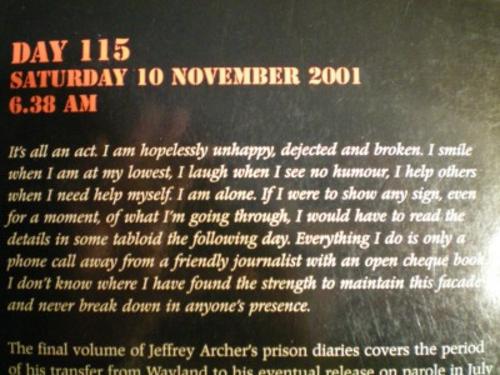
The Prison Diaries of Jeffrey Archer

Saturday, February 12, 2011

0 comments

A couple of years ago, I got addicted to the mini TV-series called "First Among Equals", which recount the political careers and personal lives of 4 young British MPs. Two of those are Tories, one posh that gets elected in a safe Tory constituency, one of those places where even a donkey could get elected if it got the Tory official nomination while the other has to fight in Labour-obsessed Coventry, one Labour MP and a Scot that ends up being the nationwide leader of the Lib Dems. I did what every decent fan should do and downloaded the stuff to watch it whenever I wanted. Furthermore, I got my hands on the novel the whole thing was based on. Its author was Jeffrey Archer. While reading about the man's life, I found some strange but interesting facts about him.

Archer was himself a Tory MP after winning the Linconshire by-election on the 4th December 1969. His political career's zenith was his appointment as the deputy chairman of the Conservative Party during the Thatcher era. In October 1986, he was forced to resign from this position after a "prostitute" scandal that got public on the tabloids. Archer sued the Daily Star and won half a million pounds which - as all good politicians have to do after winning a case like that - he donated to charity. 12 years later he was selected as the Tory candidate for the London Mayoral Election of 2000 in an effort to make a good stand against the favourite "Red" Ken Livingstone. This was not bound to happen. On the 21st November 1999, tabloid "News of the World" published certain allegations that Jeffrey Archer had committed perjury during the 1987 libel trial. Archer withdrew from the mayoral race the next day and soon got expelled from the Conservative Party. A year and a half later he was found guilty for perjury and perverting the course of justice. He got four years imprisonment. You can imagine the shock of someone coming from a country in the olive belt at learning that an MP ended up in prison for such a "crime". Where I come from, if you get elected into parliament you can be absolutely sure that such a thing will not happen to you unless you take an axe and start slaughtering people in the middle of the street or something.


Archer did an Oscar Wilde by keeping and finaly publishing his prison diaries that describe his adventures with the British judicial and penitentiary systems. His friendships with drug dealers, burglars and murderers, friendships strong, the kind that last a lifetime. You see, Jeffrey Archer was first sent to a category "A" prison inspite of the fact that this was his first conviction and did not pose serious risk or harm to the public. Despite being a former MP for christs sakes. That was and still is a fact that my Southern European mind cannot comprehend. Well what can I say. These circumstances, though unfortunate for him, gave Jeffrey Archer the proper environment to write a 3-volume masterpiece called "A Prison Diary. Volume I:Hell, Volume II: Purgatory, Volume III: Heaven", the best source of information about prisons in Great Britain I've ever stumbled upon. Gruesome and riveting!

Michael Chabon - The Yiddish Policemen's Union

Wednesday, February 9, 2011

0 comments

The Yiddish Policemen's Union: A Novel (P.S.)… by Michael Chabon

It is not often that someone can find a non-chess book - or movie - that has its chess facts right. Whenever chess is not the central element of a plot - unlike Nabokov's Luzhin Defense - chess is abused; its history, theory and practice butchered by many a good novelist. In that sense, Michael Chabon's novel was a pleasant surprise for my oversensitive, regarding chess, and always alert for misquoting and mislabeling, eyes. Openings are correctly identified, chess figures put in their correct timescale and characters read chess books that do actually exist. And Jan Timman is presented to the reader as the world champion of the game in the late 70s.. oh wait..

Well, the aforementioned "anomaly" is just one of the less important parts of an alternate world situation that Michael Chabon brilliantly developed in order to provide his story with a fitting historical context. The second World War ended with a nuclear attack on Berlin itself in 1946, Soviet Union never happened, Mantsuria is considered a world power and most importantly, the Arabs have triumphed in the war of 1948, therefore destroying the Zionist dream on his birthbed. And for good. United States of America intervene and offer a temporary home for the million of Jewish immigrants - terrified after the Holocaust and yet another war lost. A special arrangement offers to them a district in the state of Alaska. And it's there, surrounded by hostile native tribes and a suspicious US government, that Chabon's scenario takes place.

A crime and a main character that bring Raymond Chandler to mind, a great conspiracy underneath, lots of Yiddish slang and a love story resurfacing in the middle of the whole mess. All and all, it deserves the hype.

Reviewed at the social site for books and libraries http://www.librarything.com by trandism


Serge Rezvani - Enigma

Monday, February 7, 2011

0 comments

A Navy Investigator, a Poet Criminologist and a Scholar whose expertise is the history and works of the Knight family. The family yacht was found deserted in the middle of the sea, no souls on board, only their manuscripts shedding light on the personalities of their respective authors; presumed dead, drawned under mysterious circumstances. The three men, who remain anonymous throughout the text, initiate a series of dialogues between them, with the Scholar having the central stage as he gradually reads and deciphers the huge pile of manuscripts. The Poet Criminologist gets carried away and talks about literature, mostly classics, blinded by the brilliance and wide knowledge of the Scholar while the Navy Investigator tries in vain to restrain the other two men and stay on track with the investigation. Who killed the others and then committed suicide by lifting the ladder, condemning everyone including himself to a slow and torturous death in the cold waters around the luxury boat? And why?

Those who like fast mystery novels with complicated interwinned storylines and police investigating amongst suspects, members of the underground, should stay away from the book. The actual crime is used only as an excuse: references to (amongst others) Dostoyevsky, Poe, Dickinson, Thomas Mann, Joseph Conrad, Henry James, Da Vinci, the family situations of both the Criminologist and the Investigator whose lives get a new meaning by the Scholar's acquaintance and above all, the histories and works of the Knight family members, extraordinary characters all of them. Understanding them does not merely lead to the solution of the mystery, but rather to the better understanding of the human nature.
Reviewed at the social site for books and libraries http://www.librarything.com by trandism